Tagged: tools
asdf: Extendable version manager #
If your work involves multiple languages and multiple tools for managing versions, check out asdf, an extendable version manager that provides a single consistent interface for managing them all:
# List all installed ruby versions
❯ asdf list ruby
1.9.3-p545
2.1.2
2.2.3
2.2.4
2.2.5
jruby-9.1.6.0

# Install a new ruby version
❯ asdf install ruby 2.3.3

# List available nodejs versions to install
❯ asdf list-all nodejs

# Install a new nodejs version
❯ asdf install nodejs 7.7.2
I've been using asdf as my primary version manager for Ruby and Node for a few weeks and am really liking it.
h/t Adam
A CLI for Amazon Athena #
I've been enjoying Amazon Athena to analyze our application event data.
In case you haven't played with it yet, Athena allows you to query data in S3 using SQL. My only complaint so far is having to use the web interface to manage schemas and run queries. Since Amazon offers a JDBC driver for Athena, I decided to build my first JRuby app - a command line interface for Athena catalogs.
You can run queries:
❯ cat queries/count-by-port.sql
SELECT COUNT(*) AS count, elb_name
FROM sampledb.elb_logs
GROUP BY elb_name
ORDER BY count DESC
LIMIT 10;

❯ athena query queries/count-by-port.sql
COUNT  | ELB_NAME
-------|-------------
151901 | elb_demo_006
151886 | elb_demo_009
151753 | elb_demo_001
151284 | elb_demo_002
151062 | elb_demo_004
150503 | elb_demo_008
149934 | elb_demo_005
149122 | elb_demo_007
148761 | elb_demo_003
manage schemas,
❯ athena table show sampledb.elb_logs
CREATE EXTERNAL TABLE `sampledb.elb_logs`(
  `request_timestamp` string COMMENT '',
  `elb_name` string COMMENT '',
  `request_ip` string COMMENT '',
  `request_port` int COMMENT '',
  `backend_ip` string COMMENT '',
  `backend_port` int COMMENT '',
  `request_processing_time` double COMMENT '',
  `backend_processing_time` double COMMENT '',
  `client_response_time` double COMMENT '',
  `elb_response_code` string COMMENT '',
  `backend_response_code` string COMMENT '',
  `received_bytes` bigint COMMENT '',
  `sent_bytes` bigint COMMENT '',
  `request_verb` string COMMENT '',
  `url` string COMMENT '',
  `protocol` string COMMENT '',
  `user_agent` string COMMENT '',
  `ssl_cipher` string COMMENT '',
  `ssl_protocol` string COMMENT '')
ROW FORMAT SERDE
  'org.apache.hadoop.hive.serde2.RegexSerDe'
WITH SERDEPROPERTIES (
  'input.regex'='([^ ]*) ([^ ]*) ([^ ]*):([0-9]*) ([^ ]*):([0-9]*) ([.0-9]*) ([.0-9]*) ([.0-9]*) (-|[0-9]*) (-|[0-9]*) ([-0-9]*) ([-0-9]*) \\\"([^ ]*) ([^ ]*) (- |[^ ]*)\\\" (\"[^\"]*\") ([A-Z0-9-]+) ([A-Za-z0-9.-]*)$')
STORED AS INPUTFORMAT
  'org.apache.hadoop.mapred.TextInputFormat'
OUTPUTFORMAT
  'org.apache.hadoop.hive.ql.io.HiveIgnoreKeyTextOutputFormat'
LOCATION
  's3://athena-examples-us-east-1/elb/plaintext'
TBLPROPERTIES (
  'transient_lastDdlTime'='1480278335')
list and rebuild partitions, and more.
Setup instructions and full usage are in the GitHub repository.
Right tool for the job #
"Use the right tool for the job" is an oft-repeated aphorism in the tech world. In my experience, I have found this aphorism to be said a lot but actually implemented rarely and to also omit the reality of how technology choices are made.
I nodded along with Peter's real world translations for this overused phrase in tech. Development is about tradeoffs. There is rarely a single right tool for any software job.
Side-by-side diff and Git commit message editing in vim #
Adam Roben shared a handy Vim function for
opening diffs in a new vertical split when you edit your commit message with
git commit.

jq is sed for JSON #
A fantastic intro to jq, a tool for processing JSON that has transformed the way I work over the last few years.
A good vimrc #
Doug Black begins his extensive, approachable guide to organizing your .vimrc with a warning against cargo culting:
Don't put any lines in your vimrc that you don't understand.
I would agree with that statement — for intermediate and advanced users. If you're new to the shell, starting with a framework or someone else's dotfiles bootstrap can ease your immersion into text mode.
Your goal should be to get comfortable enough to craft your own workflow and build your .vimrc from the ground up.
Nomad - world-class command line utilities for iOS development #
I don't know if anybody ships like Mattt. Nomad continues a long line of work to make Apple's tools more approachable for those of us who reside in the shell:
Nashville is named after the eponymous Capital of Country Music (and Tennesee), home of the Grand 'Ole Opry and the Country Music Hall of Fame and Museum. It's part of a series of world-class command-line utilities for iOS development, which includes Cupertino (Apple Dev Center management), Shenzhen (Building & Distribution), Houston (Push Notifications), Venice (In-App Purchase Verification), and Dubai (Passbook pass generation).
Flint: lint your project for sources of contributor friction
I wrote previously on the benefits of bootstrapping consistency. Predictable scripts for automating setup and running tests greatly reduce the friction for newcomers to a project.
Recently, I've jumped back into some of my older projects and immediately felt the pain of not having bootstrap or test scripts to get up and running. Wanting a way to quickly check a project for these missing scripts and (other items that help reduce contributor friction), I wrote Flint as a small Bash script. Here's what it does:
While Bash was a good fit for the initial version, I have some ideas for Flint that really demand a higher level language:
- Open an issue in a GitHub repository. I'd like to run Flint in a project and just have it open an issue in the repo with each of the lint errors as TODO tasks in the issue body.
- Add missing files based on templates. I want to ship some default licenses (or pull them from choosealicense.com), and just add them to the project automatically. Boilerplate README, and CONTRIBUTING guides would be a logical addition, too.
Rewriting in Go
Ruby is my primary language, and I've written plenty of CLI apps in Ruby, but I thought I'd give Go a shot for this one, primarily for the reasons Mitchell Hashimoto and Jeremy Saenz have written about.
It's still early, but I've enjoyed writing a command line app in Go. Jeremy's cli.go project has captured much of the declarative expressiveness I like about David Copeland's gli CLI framework for Ruby.
Special thanks to Owen and Jeffrey for some helpful code review.
See Flint on GitHub.
Rdio-cli does lyrics #
In another dotfile discovery, I ran across makeitpersonal in Artem's dots. makeitpersonal makes it easy to fetch lyrics in plain text using curl. Naturally, I didn't waste time adding this to rdio-cli. By default, it looks up the current track, but you can override artist or song title, the former being quite useful for covers.
$ rdio current
Now playing: That Old Time Feeling / Rodney Crowell / This One's for Him: A
Tribute to Guy Clark

$ rdio lyrics
Sorry, We don't have lyrics for this song yet.

$ rdio lyrics --artist="Guy Clark"

And that old time feeling goes sneakin' down the hall
Like an old gray cat in winter, keepin' close to the wall
And that old time feeling comes stumblin' up the street
Like an old salesman kickin' the papers from his feet

And that old time feeling draws circles around the block
Like old women with no children, holdin' hands with the clock
And that old time feeling falls on its face in the park
Like an old wino prayin' he can make it till it's dark

And that old time feeling comes and goes in the rain
Like an old man with his checkers, dyin' to find a game
And that old time feeling plays for beer in bars
Like an old blues-time picker who don't recall who you are

And that old time feeling limps through the night on a crutch
Like an old soldier wonderin' if he's paid too much
And that old time feeling rocks and spits and cries
Like an old lover rememberin' the girl with the clear blue eyes

And that old time feeling goes sneakin' down the hall
Like an old gray cat in winter, keepin' close to the wall
You can install rdio-cli from Rubygems or from the source on GitHub.
Bootstrapping consistency #
One of the best features of Rails is its consistent project layout.
Thoughtbot recently shared how they use a ./bin/setup script to
bring consistency to the project setup.
Regardless of the
bin/setupfile’s contents, a developer should be able to clone the project and run a single, consistent, reliable command to start contributing.
At GitHub, we use script/bootstrap, but the idea is the same — a consistent
user experience to get from zero to productive on any new project. Whether
I'm writing docs, extending GitHub with service hooks, or
hacking our internal support tools, I know I can just clone the repository and
run script/bootstrap to jump right in. Thanks to a patch from Matt
Emborsky, this works for my dots, too.
We also don't stop with the project bootstrap. Our projects normally have
script/test for running the local test suite, script/cibuild for running
tests on the continuous integration server, as well as the usual
script/server, and script/console scripts where applicable.
As a result, I spend less time thinking what to run and just run.
vim-sensible #
A sane starting point for your .vimrc from Tim Pope, one of the
community's most prolific plugin writers.
Think of sensible.vim as one step above 'nocompatible' mode: a universal set of defaults that (hopefully) everyone can agree on.
Looks like a great starting point to build upon by cherry-picking from other people's Vim setups instead of starting with an opinionated setup and whittling down from there.
Contextual TODO list counts in your zsh prompt
One of the nuggets I picked up from Zach Holman's dotfiles was putting a count of my todo.txt items in my right side zsh prompt. That little number now nags me any time I use my terminal.
Then I had the idea of displaying contextual counts for all those TODO, FIXME, and HACK notes we often use in our projects. With some help from Jesse, my dream has come true:
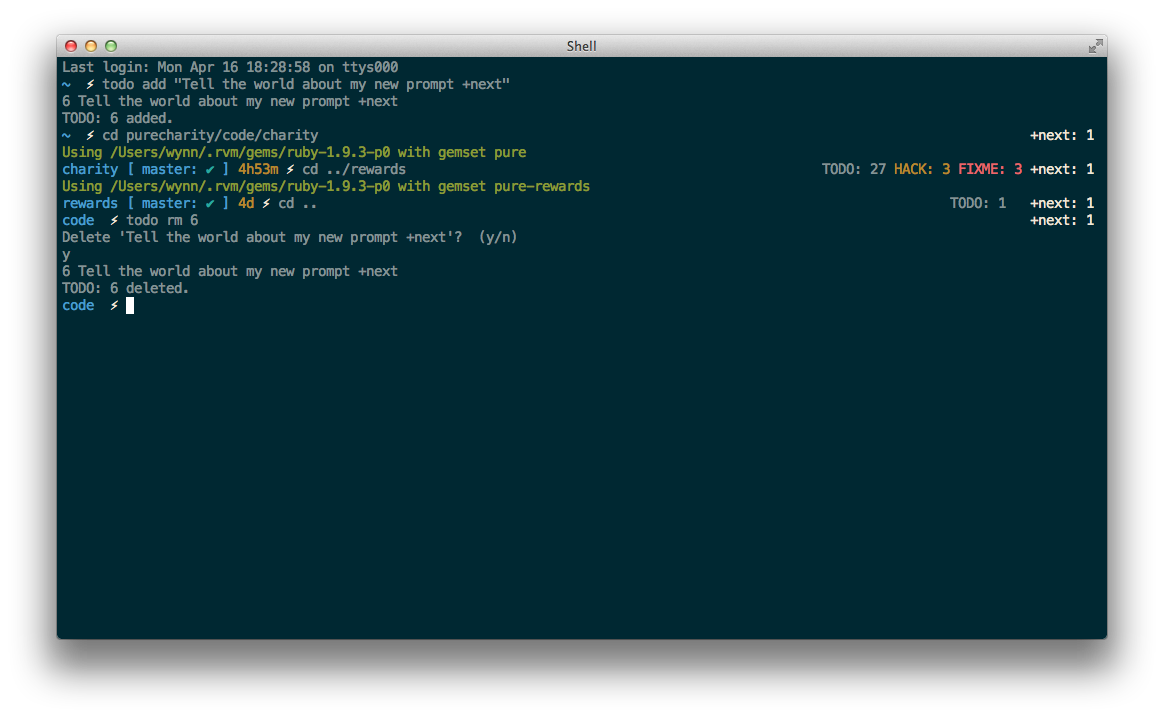
Now, if I'm in a project with any of those custom notes, the counts appear in my right side prompt in addition to my regular personal todo.txt tally. Check the function in my dotfiles repo if you're interested or have ideas on how to improve it.
Command Line Tools for Xcode #
Kenneth Reitz, creator of OSX-GCC-Installer on great news today from Apple:
Today, Apple added a beautiful new package to their official developer tools suite: Command Line Tools for Xcode. It's a 171 MB download that includes all of the tools a Homebrew should ever need. Best of all, it contains the proprietary headers that I couldn't ship myself.
You can download and try it out today. All you need is a free Apple ID.
Official Homebrew support is on the way.
To stave off further questions, yes, you can use the "Command Line Tools for Xcode" package with Homebrew. And we will support it.
— Max Howell (@mxcl) February 16, 2012
Awesome.
Directory-based environments #
Small script from Kenneth to set
up environment variables based on Foreman .env files. It's an
interesting concept that would no doubt offend some. After all,
rbenv calls
RVM's overriding of cd
"dangerous and error-prone."
As I'm managing more and more environment variables with the same names across Heroku projects lately, I'll give Autoenv a shot.
CSSWG, save us from CSS #
Compass creator and Sass core team member Chris Eppstein on the state of CSS:
The CSS Working Group needs to stop rearranging deck chairs for a while and plug the giant holes first.
He continues:
It is time for native feature detection, it is time for mixins and selector inheritance, it is time for variables, it is time for user-defined functions, it is time for better syntax. Actually, I take that back. It’s way past time. Developers have been demanding variables for their CSS for a decade and that CSS doesn’t have this feature yet is an absolute embarrassment.
I often hear from excited new Sass users that Sass is what CSS should have been. Here's to a day in the future when some of these features make it into the CSS spec and preprocessors can tackle bigger issues like spriting, asset management, and the like.
Rake - not just for Rubyists #
Chris Miller at the end of a great overview of Rake for Obj-C developers:
In closing, you don’t have to be a crazy Rubyist, or even know too much Ruby, in order to utilize Rake. It’s a powerful tool and can save you a lot of time.
Whether I'm writing mobile apps with Titanium, or writing books for Manning, Rake is a critical part of my polyglot toolchain. It's a powerful thread to stitch together CoffeeScript, Python, Sass, Haskell, and of course Ruby.
Chris' blog is worth a look. I've been enjoying his recent articles, mostly on Obj-C.
Move faster in Vim with relative line numbers #
Since 7.3, Vim has a setting called relativenumber (you can set it up with
:set relativenumberor:set rnu), which is a lot like the number setting you’re probably using to have line numbers already. But, instead of showing the absolute line numbers from the top of the file, it shows them relative to the line you’re currently on. That means the line below the current one is marked with 1, as is the line above. Now it’s quite easy to find out how many lines you need to jump up or down.
I've been trying out relative line numbers and I agree, it makes it simpler to get around in normal mode. Jeff has released a plugin to add some smart toggling based on Vim's focus state and mode.
Installed.
Metadown #
Nice gem from Steve Klabnik that extracts metadata from and parses Markdown files. Embedding post metadata in YAML format at the top of the file is a common approach employed by several static site generators such as Jekyll, Octopress, and nanoc as well as NestaCMS, the CMS that powers this site. Nesta's metadata isn't pure YAML and at times I wish it were.
Topfunky's beautifully annotated command line prompt #
Geoffrey Grosenbach and Paula Lavalle have collaborated on a beautiful breakdown of Geoffrey's ZSH prompt. If you haven't taken the time to customize your terminal prompt, I highly recommend it. Here's my setup
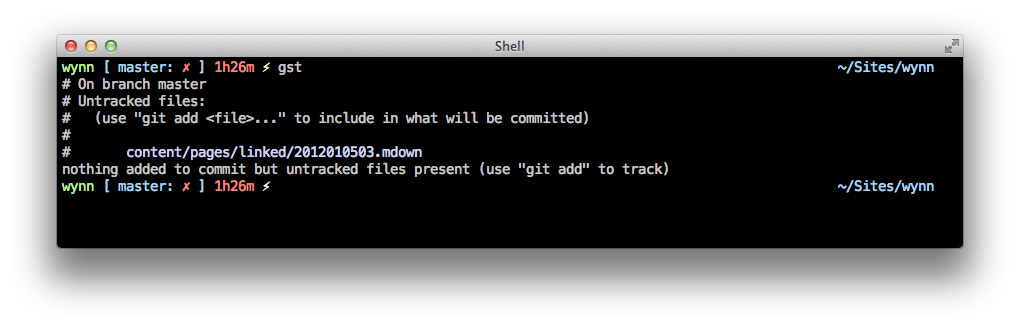
Be sure to check out Steve Losh's guide if you missed it.
WebKit gets selector profiler #
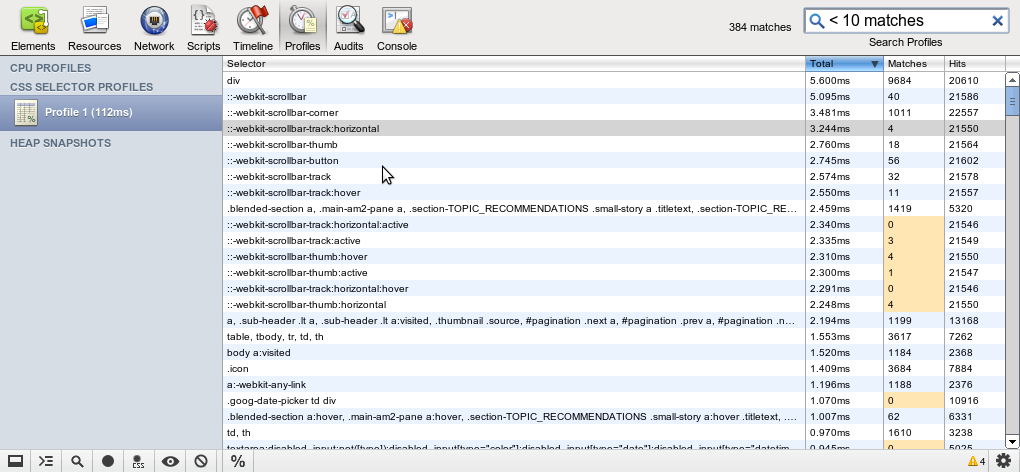
There has been a lot of talk lately about CSS selector performance. Thanks to this patch, WebKit nightlies now have a profiler to display performance of your CSS selectors.
Understand, then automate #
However, it is still vitally important that you understand how your tools work. This is particularly critical when it comes to things like preprocessors, libraries and frameworks which aim to save you time by automating common processes and functions. For the most part, anything that saves you time is a Good Thing™ but it cannot be stressed enough that using tools like these in earnest should be avoided until you understand exactly what they are doing for you (and, to an extent, how they are doing it).
I would add Rails view helpers to this list.
Ultimately, you are responsible for anything that writes code on your behalf. The great thing is, though, on an open source stack, you can dig in and not only figure out how a tool works, but how well it works.
Inexperience can play out in two extremes: cobbling together other people's code, and rejecting anyone else's code with a not invented here mentality.
Learn the Illustrator pen tool step-by-step #
Veerle has created a great step-by-step tutorial for mastering the pen tool in Illustrator in both CS5 and CS4/3 flavors.
Vim + tmux = custom IDE #
Alex Young on stitching together your own development environment with tmux, vim, and other text-mode apps:
The difference between this approach and a traditional IDE is this interface adapts around my current task, and is only limited by the thousands of commands and scripting languages that I have installed.
As a recent command-line Vim convert, I agree. I use tmuxinator to automate the process. I have tmux environments for development projects, blogging, and even GTD with taskpaper.vim.
I'm also anxious to try the upcoming iTerm + tmux integration.
Micro Gems: Brilliant #
A great idea from Jeff Kreeftmeijer for creating gems for those snippets you seem to take from project-to-project using GitHub gists:
See how easy it is to create your own RubyGem? The only thing you need is an implementation and a gemspec. Since Bang isn’t much more than that right now, I think a Gist is sufficient. At least for now.
Another reason I love Bundler.